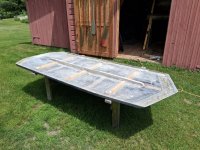
Boat building: Stiffening a plywood hatch cover -- I don't want it to flex.

Matthias

Member
Supporter
IMG_5210.jpgIMG_5222.jpg
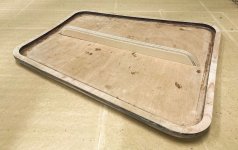
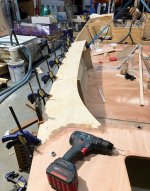
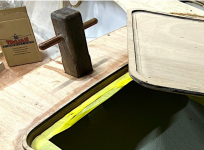
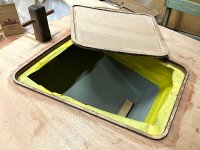
At the moment I'm working on the lid for the anchor well.
It's 2 layers of 6mm (1/4-inch) Gaboon plywood and I want to be able to stand on it, even step down off a dock onto it without it flexing.
I'm not sure if a couple layers of glass inside and out will increase its rigidity enough and thought it probably needs some sort of webbing on its underside.

IMG_5263.jpg
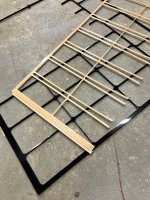
At work we just laser cut a bunch of acrylic plaques, and looking at the waste got me thinking! (insert eye roll)
IMG_5264.jpg
What if I glass in the acrylic waste, double stacked, as webbing to the underside of the lid? I'd probably have to vacuum bag it.
Is this a valid idea or should I make some sort of webbing or stiffening batton from plywood instead?

Lid is about 19.5" long by 15.5" wide.

If it was your boat, how would you make it? What's the best way to get the lid super rigid?
 
Last edited:

Matthias~

This is one of those seat-of-the-pants engineering challenges we all face. Sometimes we just need to try something. My instinct would be to glue-and-glass 2 cleats that were scribed to the curve of your cover. I would use lengths of Mahogany or SYP - 3/4 thick by about 1.5 inches tall. All edges rounded.

Here is how I stiffened a much larger cover (for an Arthur Armstrong Blackjack). The crosspieces were PVC lumber (no inherent stiffness) and the longitudinal was clear SYP.

sm Galati cockpit cover - sanded before final epoxy.jpg

Having said that, your approach could certainly work - especially if you have ready access to vacuum bagging. Can you test on a piece of hatch stock you will not need? Your webbing would probably weigh less and rob less volume from the hold.

All the best!

SJS
 
Matthias~

This is one of those seat-of-the-pants engineering challenges we all face. Sometimes we just need to try something. My instinct would be to glue-and-glass 2 cleats that were scribed to the curve of your cover. I would use lengths of Mahogany or SYP - 3/4 thick by about 1.5 inches tall. All edges rounded…
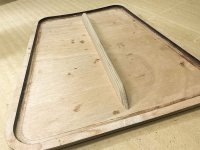
Thanks for the reply Steve, probably while you were typing I was sanding and came up with a simpler, more elegant solution similar to what you did.

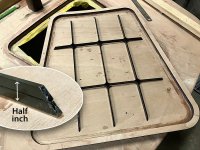
Just went with one rib 5/8 ply about 1.25 high…
If I go down this path it’ll be simpler to construct — glue and fillet, then cover with 400gsm biaxial tape. Also sheath the top of the hatch with HD 800gsm woven cloth leftover from glassing the motor mount.

8FD53BFF-0149-4C54-8847-B5B10C76ADCB.jpeg7D56D02D-94DF-4A57-A3B6-E652B1788269.jpeg
 
If it was your boat, how would you make it? What's the best way to get the lid super rigid?

Foam and Foam core material is the "professional" choice to add rigidity to a panel. Divinycell was the material used in my previous vessel. Several options to choose from if you wish to go this route. The major advantage to a core of foam, is for the most part, a foam core tends to spread the load out evenly across the panel. A single or even multiple ribs will carry the load along each rib. Each rib becomes a place where the stress concentrates.
 
Last edited:
Foam and Foam core material is the "professional" choice to add rigidity to a panel. Divinycell was the material used in my previous vessel. Several options to choose from if you wish to go this route. The major advantage to a core of foam, is for the most part, a foam core tends to spread the load out evenly across the panel. A single or even multiple ribs will carry the load along each rib. Each rib becomes a place where the stress concentrates.
Wow, Interesting! I had no idea that foam could be used in that way, so never considered it as an option. Unfortunately the closest supplier of Divinycell is 1.5hrs drive away and I would need to buy a full sheet for $130.

I’m gonna go check out my local hardware store and see what they offer in the way of rigid foam insulation boards. Checking online — looks like I can get half a sheet for $20. If it feels rigid I’ll buy it and do some experimenting.
 
Wow, Interesting! I had no idea that foam could be used in that way, so never considered it as an option. Unfortunately the closest supplier of Divinycell is 1.5hrs drive away and I would need to buy a full sheet for $130.

I’m gonna go check out my local hardware store and see what they offer in the way of rigid foam insulation boards. Checking online — looks like I can get half a sheet for $20. If it feels rigid I’ll buy it and do some experimenting.
Not sure if "regular" foam board would have the same properties, it might. My understanding is the foam core used with resin and/or epoxy will absorb and bond with the resin.
 
Is the lip that the hatch sits on built to hold the load? I’d also want a way to secure the hatch in place so it doesn’t slip out from under me and send me in the drink headfirst
 
Is the lip that the hatch sits on built to hold the load? I’d also want a way to secure the hatch in place so it doesn’t slip out from under me and send me in the drink headfirst
It will be secured but I haven’t worked it out yet. Somehow it will be hinged and latched.

The little lip on the deck is just epoxy glued and only intended to mitigate water running into the anchor well. I have a drain built into the well, but didn’t want excessive water entering.

The lip on the lid itself is epoxy glued and will have glass around its perimeter for added strength.
 
Just an example of how a foam core is used. This example is a lightweight solo canoe I have. The photo is stolen from the manufactures web page.

The foam core is used as ribs for the sidewalls and across the entirety of the floor area. The inner layer of glass has no colorant. Don't remember just how thick the core material may be in this example. I'd have to get into the attic area of my garage to look at it and make a guess estimate.
1771759028083.png
Ultra-light hulls are stiff and incredibly light. They are ideal for speed and distance paddling and for all people or conditions that demand the lightest gear. In our Ultra-light construction a structural-foam core and ribs are laminated into the hull and sides. We also add extra fabric layers to strengthen specific targeted areas. Aluminum plates are strategically laminated into the hull. Seats, footbraces, and all hardware is then riveted into these plates. This gives a very secure connection and eliminates rivet heads on the exterior. Aramid, the fiber used for aerospace, body armor and bulletproof vests, is amazingly light and strong. We've used it for more than 30 years to construct extremely light and tough canoes. Wenonah Canoe is the worlds largest maker of canoes using Aramid.

====================================================================
That said, using single or multiple ribs is certainly an option. The ribs themselves don't need a lot of rigidity. The strength comes form the vertical walls of resin/glass laid up and over each rib. Yes, vacuum bagging would be the ideal method for either a foam core or rib(s) style "core".
 
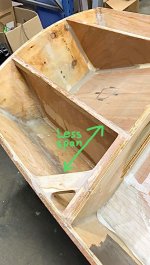
I've never seen an angled cut like that where the front deck meets the sides. Intriguing. What is this approach?
Some of my boat building processes are probably unconventional because I don’t exactly know what I’m doing and have no references or experience to draw upon.
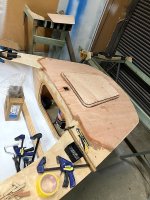
The weird cut shape of the panels is just because that’s how the bracing underneath was constructed.

A couple of reasons:
1/ I wanted more surface area to be able to fair the bow deck and the deck sides together because I was worried that the sides wouldn’t bend to match the slight curve of the bow deck.
2/ I wanted more contact area underneath for screwing into. (I will have to research what you mention about cleats underneath, I don’t know what that means)
3/ By adding the diagonal brace the bow deck didn’t have to span so far (arrow on picture) In hindsight this was probably not an issue because the chamber underneath is filled with pouring foam.

Cutting shapes to match, or cutting unconventional shapes makes no difference to me because it’s all done on the CNC. If I was doing it by hand I would have chosen a simpler cut/joint.

EF965787-1996-4EB1-B761-23A53ACF5D88.jpeg9FAE4D44-D99A-427F-A68E-1A6C9B6E3AA0.png880D46D1-70DD-4FEC-A9FA-74D989F8265F.jpeg
 
Last edited:
Matthias

That all makes sense and sure looks like a robust way of doing things. I'm not seeing short cuts. I see well thought execution. FYI, a cleat is simply a board scabbed on to another to act at an attachment point or rest.
 
Last edited:
Mattias,
Is the 2"×2" a receiver for a hitch mount winch? If so, love it!
Sorry RM I don’t know what you’re referring to.
Are you asking about this…
C5F230EF-200E-4C5C-91A9-58B4DD07D5B2.jpeg

If so, then sorry to disappoint, it’s just my bow roller for the anchor. Here’s a better picture…
904B2FC3-D072-4442-8E2B-665453FD602F.jpeg

But on the topic of winches, I saw a video come through my socials recently of a lightweight, portable winch that was like a Come Along but much smaller and apparently a brand new design. I was going to reference it here because I’d like something like that for the boat, but can’t find it online anywhere :(

EDIT: Found it, it’s called Dragan Systems Pocket Winch
https://dragansystems.com/?srsltid=AfmBOoqSCMoOG-qlms8ruh9iiigZ5oCohQja3h6syzyMBFNKG-cTfLZJ
But it’s not cheap, and thinking about it again, for that price I’d maybe consider an electric winch.
 
Last edited:
Matthias

That all makes sense and sure looks like a robust way of doing things. I'm not seeing short cuts. I see well thought execution. FYI, a cleat is simply a board scabbed on to another to act at an attachment point or rest.
Eric, I do spend a bit of time trying to work out how to do things. Shortcuts? Hmmmm, some of my sanding could definitely have more time spent, but I keep telling myself it’s a home-made boat so to some degree it should reflect that — which for me means that it doesn’t have to be perfect. This whole exercise is one of learning and gaining experience so that the next one will be better.
 
Sorry RM I don’t know what you’re referring to.
Are you asking about this…
View attachment 73974

If so, then sorry to disappoint, it’s just my bow roller for the anchor. Here’s a better picture…
View attachment 73975

But on the topic of winches, I saw a video come through my socials recently of a lightweight, portable winch that was like a Come Along but much smaller and apparently a brand new design. I was going to reference it here because I’d like something like that for the boat, but can’t find it online anywhere :(

EDIT: Found it, it’s called Dragan Systems Pocket Winch
https://dragansystems.com/?srsltid=AfmBOoqSCMoOG-qlms8ruh9iiigZ5oCohQja3h6syzyMBFNKG-cTfLZJ
But it’s not cheap, and thinking about it again, for that price I’d maybe consider an electric winch.
Matthias,
No this 2x2 thing sticking out of the deck. Looks like you have a hitch reciever below deck. I was thinking a winch for a small atv.
RM
65762-fe9320ff0a550bdbd103ecc1f9d298ee~2.jpg
 
Matthias,
No this 2x2 thing sticking out of the deck. Looks like you have a hitch reciever below deck…
Very intuitive RM, are you psychic? You are actually correct, I do have a receiver hitch of sorts under the deck!

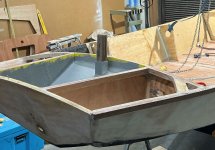
I'll go into more detail, later in my build thread because there is actually a cool story behind the construction of the bollard.

But briefly — I found an off-cut of aluminium square tube in our scrap pile which happened to be the perfect sleeve for the bollard. Later when I’m ready to mount the bollard I’ll pour in some epoxy to glue it in. It would have been too complicated to glass the bollard into the anchor well once the deck was on, and I wouldn’t have been able to already paint the well which was much easier while it was open.

A9DE7385-9EC7-4B01-8CFD-8D37FE37C494.jpeg
 
Back
Top