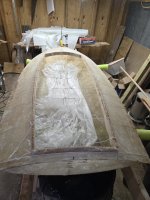
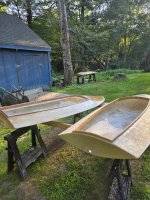
I've made good progress finishing the hulls, most annoyingly figuring out how to complete the coamings. No picture to share at the moment, but basically the fiberglass cast coaming was cut away and replaced with mahogany. A substantial fillet of thickened epoxy supports it against the deck, and the mahogany is then encapsulated in glass. I suspected this would be a problem going in, at least I can say I told you so.

I decided to tint the resin rather than paint later. I got a color called Camel Brown from a local shop, it appears reasonably close to dead grass to my eye so I think I'll continue with all four hulls. I've tinted resin before, my gripe is that it makes the cured resin difficult to sand- kind of medium soft plastic that clogs the sandpaper. I'll suffer through it.
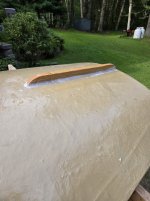
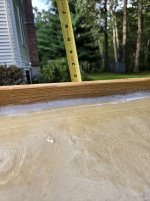
I bounced the idea of a skeg around in my head since I built the first pond box last year. That one did not have a skeg. We rowed it a bit, it takes discipline to maintain a line without a skeg in these short hulls. The boats are only nine feet so I chose 24" as a suitable length. There was some decent white oak laying around in the shed, which I planed to a proud 7/8" and ripped to 1-5/8". I chose not to taper the skegs as the hulls will be hand loaded in trucks and dragged across the marsh. Too much chance of a crack. They are fastened to the hulls entirely with thickened resin, and will then be encapsulated with cloth tape. As with everything on these builds, I'm experimenting. My gut says it will be durable, but I may chicken out and install a backer in the bilge, then drive a screw or two through the bottom. There' still time for field modification.
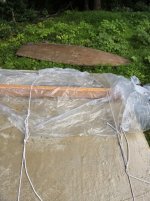
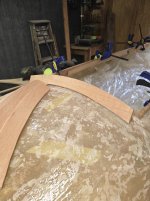
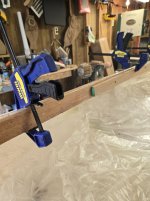
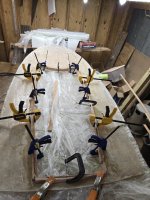
As mentioned previously, it's almost impossible to clamp effectively on the curved hulls without a bunch of blocks. I found that binding with string does a good job securing glued pieces. The plastic sheet is 100% effective at eliminating adhesion, either to the resin, the part, or the string. I wish I figured this out roughly 40 builds ago.

 ) is easily sourced in a day or two online, but it's a haul to handle most toys and gear before buying.


 It's a two man job to buck up the inside of the tube with a piece of railroad track and tap the brass over on the exterior. Hopefully my buddy will come over this weekend. Years ago I had a bolt setup with two flanges that allowed you to bend the tube by cranking down on the bolt, but it got lost. Gremlins.